
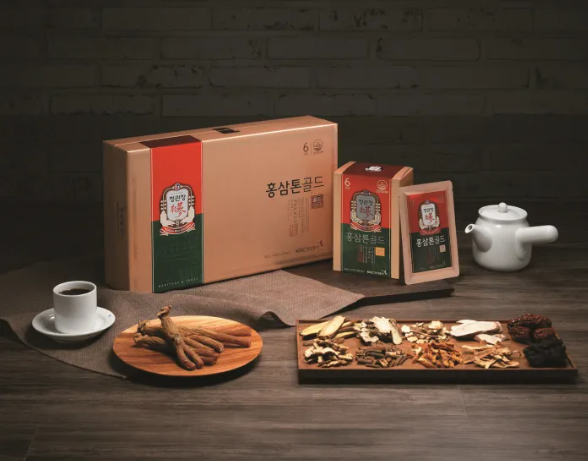

I keep thinking about this when I walk past a JungKwanJang store in Korea.
From the outside, nothing looks particularly exciting.
No huge line.
No people taking selfies.
No trendy interior.
Sometimes, the store almost looks empty.

And yet, JungKwanJang is one of those businesses that makes me wonder whether I’m looking at the wrong thing.
In 2025, KGC Ginseng Corporation recorded about ₩1.14 trillion in sales and ₩102.8 billion in operating profit.
But sales actually fell 12.6% from the previous year.
And operating profit?
It increased 4.7%.
That made me stop for a second.
A business can sell less and still make more money.
Maybe that’s something we forget when we look at stores from the street.
We see the empty seats.
The quiet entrance.
The lack of a queue.
And we assume the business must be struggling.
But maybe we’re looking at the wrong thing.
Maybe the real business isn’t the number of people standing inside the store.
It’s how much each customer is worth.

JungKwanJang isn’t really selling excitement.
It’s selling something much harder to create:
trust accumulated over decades.
JungKwanJang is the flagship red-ginseng brand of KGC Ginseng Corporation, which has been building its business around Korean red ginseng for generations.
But that alone doesn’t explain why the name has lasted.
Korea has repeatedly produced major companies that tried to turn their corporate reputation into health-food brands.
Ottogi → NatureBy
Lotte → HealthOne
LG → Ciaat / CheongYoonJin
CJ → CJ Nutra
Chong Kun Dang Health → Healthbell Story
Some of these brands disappeared. Others were reorganized or faded from public view.
JungKwanJang, however, kept accumulating something that is difficult to reproduce:
brand history, consumer trust, physical stores, gifting culture and distribution infrastructure.
And then I heard another story.
Apparently, getting a JungKwanJang dealership is “like trying to reach the stars.”
Someone told me it can be harder to get one than to get a job at a major corporation.
I don’t know if that’s literally true.
But I found the idea fascinating.
Because this isn’t the same as opening another trendy pop-up store.
You can’t simply see a popular product on Instagram and decide, “I’ll open one of those tomorrow.”
There is an established brand, a distribution network, products with decades of history, and an existing customer base behind the store.
And that’s what makes the contrast with today’s pop-up culture so interesting to me.
A pop-up has to create desire.
JungKwanJang has already spent decades creating trust.
One needs attention.
The other has accumulated recognition.
One might disappear when the next trend arrives.
The other is quietly waiting for its customers to come back.
So maybe an empty-looking store isn’t necessarily a failed business.
Maybe sometimes, the quietest store on the street is the one with the most interesting business model.
Business performance:
An article from The Korea Times
Jung Kwan Jang remains No. 1 in global ginseng market for 12th year
While South Koreans naturally grow up knowing about ginseng, it is also becoming increasingly known to people around the world.
Cardi B
https://www.instagram.com/reels/DHY37HbMtkt/
Leave a Reply